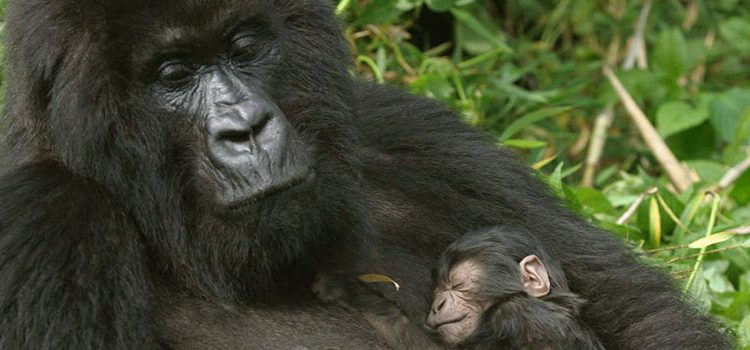
Gorillas are divided into two species. These include the western gorilla, further divided into western lowland gorillas and Cross River gorillas, and the eastern gorilla, divided into mountain gorillas and eastern lowland gorillas.
Gorillas share a large amount of DNA with humans, making them one of our closest relatives. They are the largest apes in the world and are found only in Africa. There are not many major differences between the gorilla species, aside from where they live and some behavioral traits.
Most gorillas live in groups of 5 to 30 individuals, though this number can change due to deaths, fights for power, and other factors.
Species of Western Gorillas
Western Lowland Gorillas
Western lowland gorillas live in the forests of Cameroon, the Central African Republic, the Democratic Republic of Congo, Equatorial Guinea, Gabon, and Angola. They are found in swampy forests, lowland tropical forests, and forests near rivers.
Western lowland gorillas are a subspecies of the western gorilla and the smallest of all gorilla types. They are also the most studied and observed gorillas. An adult male usually weighs between 140 and 170 kilograms and can reach a height of 1.5 to 1.8 meters, though males in zoos can weigh more than 270 kilograms.
Western lowland gorillas have the largest population among all gorilla subspecies. They have a noticeable brow ridge, a broad skull, a large head, and opposable thumbs. They walk using their knuckles and develop a patch of grey hair on their backs as they age.
Cross River Gorillas
Cross River gorillas are another subspecies of the western gorilla, first recognized as a separate group by Paul Matschie in 1904. These gorillas live in Takamanda National Park in Cameroon and Cross River National Park in Nigeria.
Takamanda National Park and the Kagwene Gorilla Sanctuary in Cameroon were created in 2008 to help protect Cross River gorillas. The sanctuary covers about 19 square kilometers between the Nijikwa and Mbulu forests.
Cross River gorillas are the most endangered gorilla subspecies, with fewer than 250 mature individuals left in the wild according to a 2014 survey. They build their nests depending on the season and changes in the environment.
These gorillas live in smaller groups of 5 to 7 individuals, unlike other gorilla species. Each group is led by a single silverback who controls the group and holds the sole right to mate with the females.
Cross River gorillas are herbivores, eating leaves, stems, shoots, bark, fruit, and occasionally ants, termites, and insects.
Female Cross River gorillas reach sexual maturity between the ages of 9 and 10, earlier than the males. They can give birth every 4 to 6 years, with relatively low fertility, being fertile for only 1 or 2 days each month. Once a baby gorilla is born, the mother breastfeeds it for about 3 to 4 years. Ready to see gorillas in the wild? Browse our gorilla safaris in Africa.