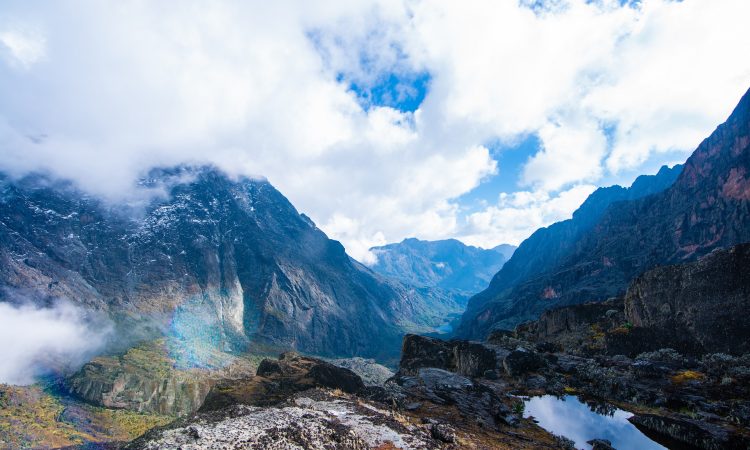
Rwenzori Mountains National Park, home to the Mountains of the Moon, is located at the border of Uganda and the Democratic Republic of Congo within the Rwenzori Ranges.
Standing at an elevation of 5,109 meters above sea level, the Rwenzori Mountains’ rivers are believed to be among the sources of the River Nile.
The mountains were formed during the Pliocene epoch, as a result of an uplifting block of crystalline rocks millions of years ago.
The vegetation ranges from tropical rainforests to giant groundsel, bamboo zone, giant lobelia, heather, and snow.
The permanently snow-capped peaks have glaciers. Mount Margherita peak and Mount Stanley are the third highest peaks in Africa. Mount Speke comes in 4th position, and Mount Baker comes in as the 5th highest peak.
This is the only national park in Uganda that offers amazing mountaineering experiences.
Check out our Uganda safaris to start planning your trip or continue reading below.
The Naming and Early Exploration of the Mountains
Ptolemy Claudius, a geographer of the Greek empire, gathered information about the snow-capped mountains of Africa and considered them to be the source of the Nile. He then named them the “Mountains of the Moon.” Sir Samuel Baker and Gessi Romolo were the first to glimpse the Mountains of the Moon from a distance.
The following year, Henry Stanley instructed his deputy W.G. Stairs to carry out a trip to the mountains, and he managed to climb to 3,254 meters, where he observed snow-capped peaks.
Wildlife of Rwenzori Mountains National Park
Rwenzori Mountains National Park is home to 70 species of mammals. Some of the wildlife that inhabits the park includes hyrax, L’Hoest’s monkeys, black and white colobus monkeys, elephants, chimpanzees, and duikers, among others.
Facts About Rwenzori Mountains National Park
The Rwenzori Mountains, the largest in Africa (120 km long, 65 km wide), with an altitude range of 1,600m to 5,109m above sea level, claim the title of the highest mountain range in Uganda and third in Africa.
These mountains have been tagged “The Mystical Challenge.” Often referred to as the “Mountains of the Moon,” they are the snowy source of the Nile, as noted by early geographers.
Unlike East Africa’s other major mountains, the Rwenzori range is not volcanic but rather a block of rock up-faulted through the floor of the Western Rift Valley.
These fabled Mountains of the Moon lie in western Uganda along the Uganda-Congo border. Their equatorial snow peaks, including the third highest point in Africa, are a sight to behold, while the lower slopes are adorned with moorland, bamboo, and lush montane forest. Giant tree heathers and colorful mosses drape across the mountainside, accompanied by towering lobelias and “everlasting flowers.”
The name “Rwenzori” derives from the local Bakonzo people’s word “Rwenjura,” meaning “rainmaker,” a fitting name given the mountains’ consistently misty peaks and abundant rainfall.
At the pinnacle of the Rwenzori range stands Margherita Peak, named after Queen Margherita of Italy. Rising to 5,109 meters, this summit offers trekkers a challenging yet rewarding ascent.
Despite their tropical location, the Rwenzori Mountains are adorned with snowfields, a result of the interplay between altitude and climate.
The mountains are also a biodiversity treasure, home to a wide range of plant and animal species, many exclusive to this area, shaped by the varying altitudes that create habitats from rainforest to bamboo thickets to highland meadows.
The Rwenzori Mountains hold a special place in the hearts of the local Bakonzo people, whose culture and customs are closely tied to the mountains. Explorers can engage with the Bakonzo community during their trek, offering a window into daily life shaped by the mountains.
History of Rwenzori Mountains
Rwenzori Mountains National Park was established in 1991 and later recognized as a World Heritage Site by UNESCO in 1994. From 1997 to 2001, rebel militias occupied the Mountains of the Moon, and the park was declared a Ramsar site in 2008.
The existence of the Mountains of the Moon was not confirmed until 1876, when Henry Morton Stanley first glimpsed the mountain ranges. In 1888, he noticed what he initially thought was a cloud but later realized was mountain slopes covered in snow.
Several explorers attempted to reach the peak of Mount Rwenzori over the following years. G.W. Stairs reached 3,000 meters in 1889, and two years later, Dr. Franz Stuhlmann and Emin Pasha reached a range and discovered there were many other ranges, not just one.
Years later, Elliot Scott attempted to climb and pushed higher into the Mubuku and Bujuku valleys. In 1900, J.E.S. Moore reached the glaciers, and in 1904, Dr. J.J. David from the Congo reached the Stanley Plateau.
Grauer climbed to Grauer’s Rock on Mount Baker in 1906, H.B. Wollaston climbed Wollaston Peak on Mount Baker, and later the Duke of Abruzzi climbed six glaciated massifs. The famed mountaineer Noel Humphreys, of Mount Everest fame, made seven trips in 1930, and a number of new routes were climbed by Tilman and Shipton in 1932.
Several mountaineers went on to establish different routes, and the Congo side of the mountain was included in what was then Albert National Park, now known as Virunga National Park. During the 19th and early 20th centuries, photographer Vittorio Sella took photos of the Rwenzori glaciers.
Location of Rwenzori Mountains
Rwenzori Mountains National Park is situated in the western part of Uganda, at the border of the Democratic Republic of Congo.
You can access the park by road from Kampala via the Fort Portal-Mubende road, taking 5 to 6 hours. Alternatively, visitors can use standard chartered flights from Kajjansi Airfield or Entebbe International Airport to Kasese Airstrip.
Mountain Climbing in Rwenzori
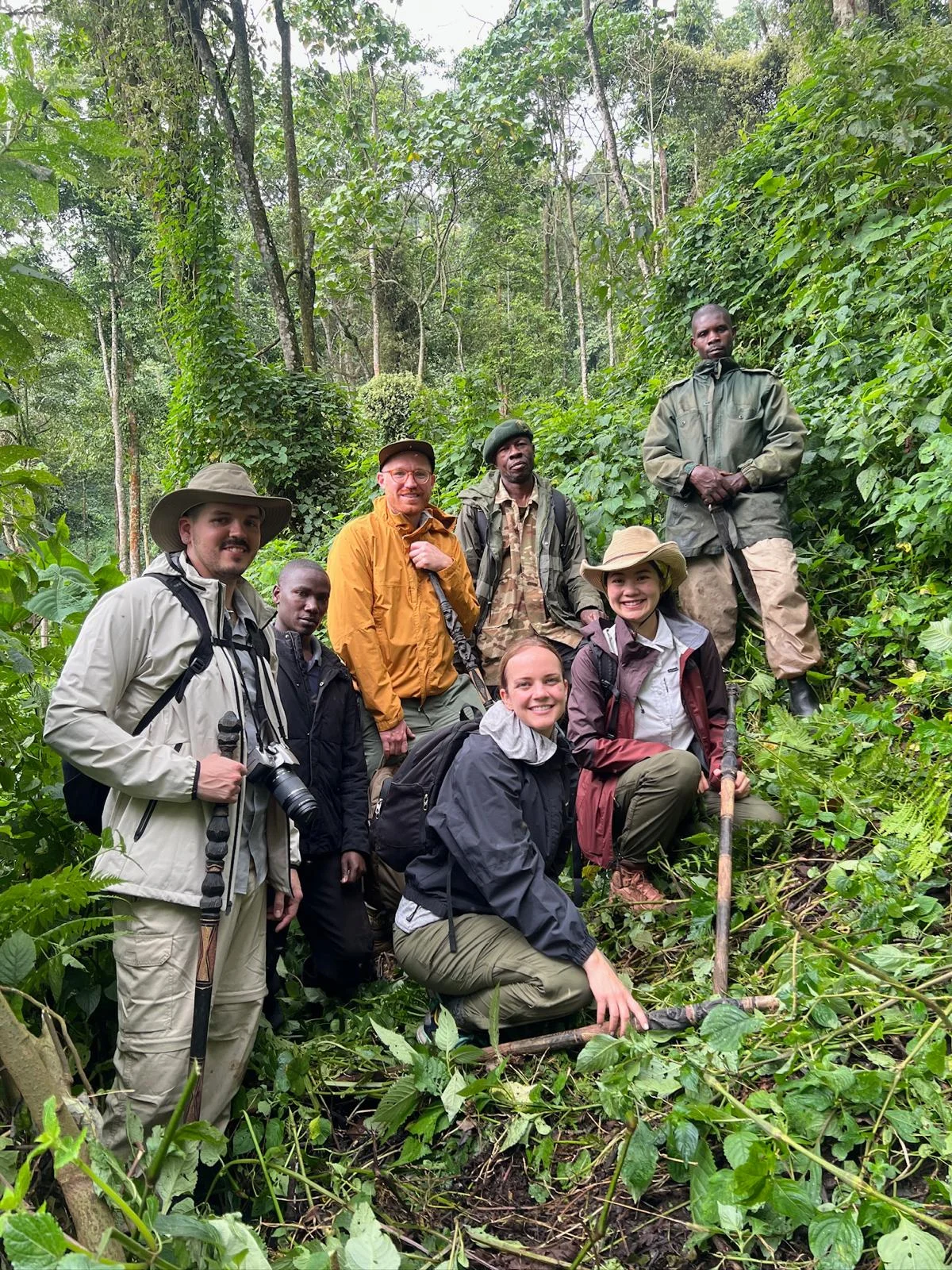
Mountain climbing is the main activity at Rwenzori Mountains National Park. Hiking can also be done at the foothills for those who don’t want to conquer the peak, with different trails set up to give you a feel of the mountain and spectacular views. Even at the foothills, hiking can be complemented by fishing using local methods in the flowing streams.
Kilembe Trail: This route passes through the Nyamwamba valley, going through glacial lakes, then joins the central circuit from Lake Kitandara. This recently established route provides striking views of Baker Peak along the way.
Central Circuit: This trail starts at Nyakalengija and is the hardest to use, passing through the Nyabitaba and Bujuku valleys before joining the central circuit and the Mubuku valley. Despite being the hardest, it offers the most striking views of all the routes. Porters are available to help carry backpacks, and guides are well trained and knowledgeable about the mountain’s diversity.
Rwenzori Entry Fees
Foreign non-residents pay $35, foreign residents pay $25, while East African residents pay 15,000 shillings.
Both foreign residents and foreign non-residents pay $50 for mountaineering fees, while East African residents pay 50,000 shillings.
Wildlife and Animals
Rwenzori Mountains National Park is home to various wildlife, including Rwenzori duikers, black and white colobus monkeys, chimpanzees, forest elephants, hyrax, L’Hoest’s monkeys, Rwenzori otters, bushbucks, leopards, Angolan colobus monkeys, giant forest hogs, and many others.
Top Things to Do in Rwenzori Mountains National Park
Bird Watching: Rwenzori Mountains National Park is a birder’s paradise, home to 217 species of birds, 17 of which can only be found within Rwenzori and nowhere else in the world. Some notable species include the Rwenzori batis, cinnamon-chested bee-eater, barred long-tailed cuckoo, Rwenzori turaco, handsome francolin, long-eared owl, Archer’s robin-chat, strange weaver, white-starred robin, slender-billed starling, montane sooty boubou, bush shrike, blue-headed sunbird, regal sunbird, and white-starred bush robin, to mention a few.
Ruboni Community Group: The foothills of the Rwenzori Mountains are occupied by the Bakonzo, also known as the Bakonjo people. The farming village of Ruboni is one of the communities you can visit while at Rwenzori Mountains National Park. These community tours offer a picture of the Bakonjo’s day-to-day activities, including basket weaving and the use of different plants for ailments, along with performances from local traditional dancers who share stories about the mountains.
Hiking and Guided Nature Walks: Guided nature walks and hikes in the Rwenzori Mountains can be done through Lake Mahooma, the Buraco Chimpanzee Forest Trail, and the Kichamba trail, offering spectacular views of the farmlands and settlements, along with encounters with wildlife, especially primates, and various bird species.
When to Climb Mount Rwenzori
The best time for visiting Rwenzori Mountains National Park is during the dry season, in the months of June to August and December to February. These are the best months for climbing the mountain, since the trails are less muddy and slippery.
It should be noted that Uganda’s climate is very unpredictable, and even in the dry season, rain can fall, though the chances are minimal.
Tourists visiting for mountaineering experiences should bring warm long-sleeved clothing, raincoats, jackets, plenty of drinking water, energy snacks, good hiking boots, garden gloves, insect repellent, sunscreen, and hats, among other essentials.
Rwenzori Mountains National Park can be reached from Kampala through Kasese within 5.5 hours. Alternatively, you can fly to Kasese and then drive to the park if you’d rather avoid long hours on the road.
Accommodation: Where to Stay
Tourists visiting Rwenzori Mountains National Park can stay at Hotel Margherita, Katara Lodge, Rwenzori International Hotel, Tropical Savannah Guest House, Equator Snow Lodge, and many more.
Please note that when hiking, you will sleep in shelters built within the hiking points.